The evolution of the customer journey experience
In years gone by, brands dictated the customer journey, delivering experiences based on the known behaviors or attributes of different customer cohorts. While some level of personalization is possible this way, true individualization can never be achieved—the brand has always predefined the outcomes.
Times have changed. The research reveals that industry leaders have integrated AI-driven CX platforms into their tech stack, meeting customers' demands for personalized experiences.
Forward-thinking organizations know they need to prioritize seamless, individualized customer journeys in today's crowded marketplace. It sets them apart, driving:
- Greater customer loyalty
- Cost reduction
- Higher revenue and growth
- Increased CSAT
- Brand advocacy
As a result, customer journeys have taken center stage in the strategic decision-making process of an increasing number of businesses.
Alterian and CX Network's The State of the Customer Journey Experience report found that 54% of organizations rank CX strategy as a high priority moving into 2024, and 32% say it's the top priority with the highest importance.
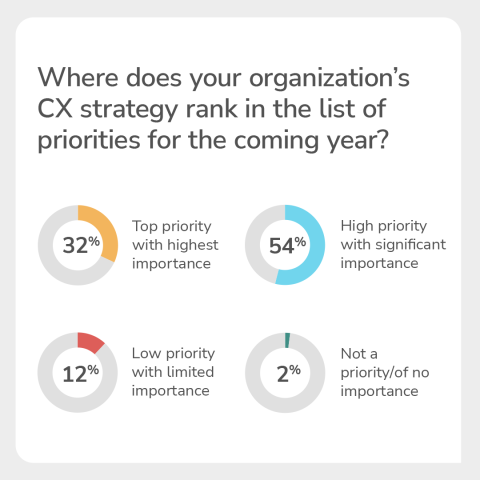
However, that sentiment isn't evenly spread across different regions. Only 27% of organizations within North America say CX strategy is their number one priority in the coming year, compared to their EMEA counterparts at 42%.
A mature CX approach ingrained in business operations is the key to long-term competitive advantage.
CX maturity: how are organizations tracking?
The majority of brands acknowledge the importance of customer journey experience. However, there are still considerable gaps when it comes to CX maturity.
While some early adopters have recognized the long-term advantages of a mature CX approach and taken the steps to integrate it into their core business strategy, many are still falling behind. Some are in the early stages of aligning their strategies with the evolving customer journey landscape, while others have not even started the process. This is despite the increasing presence and availability of AI-driven tools such as customer journey analytics and journey orchestration technologies.
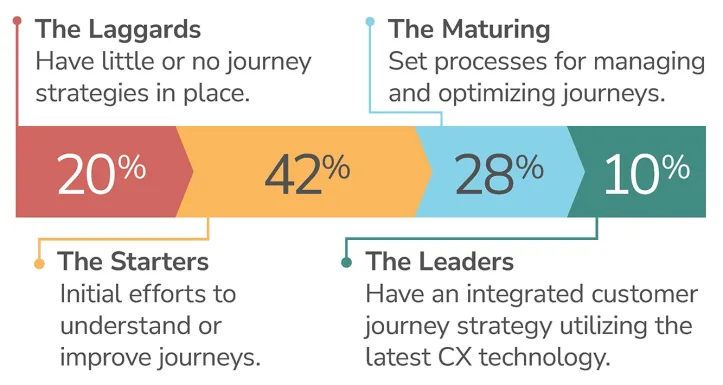
Only 10% of CX leaders say they have an integrated customer journey strategy utilizing the latest CX technology. Meanwhile, 20% admit to having limited or no formal customer journey strategies in place.
EMEA companies feel far more confident in their existing journey management abilities. Close to 65% of companies in the EMEA region rate their customer journey management performance as better or much better than that of their competitors. In contrast, only 38% of businesses within the USA and Canada said the same.
Digging a little deeper, leaders within telco and utilities are less satisfied with their current journey technology solutions, while 33% of healthcare leaders rated their current technology setup as excellent, as did 33% of leaders in the business sector. Meanwhile, 66% of leaders within the competitive retail space rate their current customer journey management experience as good.
There are clear divides that cannot be ignored. As Bob Hale notes, "while it is promising that many businesses have started their efforts to enhance customer journeys, the gap between these organizations and the leading organizations is considerable."
These gaps represent a critical point in today's business environment. If not bridged, the impact on current businesses, customers and the broader landscape will be significant. Those who are slow to adapt to the evolving CX dynamics are at extreme risk of becoming irrelevant.
Most businesses acknowledge that it's not just about transactions; it's about understanding all customer journey behaviors.
Today, customer journey experience is the top differentiator. Businesses must leverage the right technologies to understand customer journeys and create seamless and individualized interactions.
What can we draw from these insights?
CX is evolving at a rapid pace, driven by changing customer behaviors and technological innovation. As the world and the CX landscape continue to change, organizations must prioritize the customer journey experience if they are to keep up with the needs of their customers and maintain a competitive edge. This means investing in the tools and technology that enable them to deliver customer-led journeys at every point.
As revealed in the report, organizations aren't progressing at the same pace. There are strong leaders and clear laggards.
Hale states: "Those who do not act quickly risk losing customers to more innovative rivals. In a rapidly evolving landscape, failure to adopt new technology hampers the ability to catch up, leading to long-term customer, revenue and market share loss. Early adopters, however, stand to gain a significant competitive advantage."
The edge lies with the brands that have actively integrated customer-centric solutions into their broader business strategy, embracing customer journey experience technology to deliver seamless and individualized journeys. Those who are yet to do so are set to find it increasingly challenging to remain competitive and reduce costs. It's those who choose to embrace this shift and prioritize customer-centricity that will be the ones who flourish and thrive.
Read the full research report
Benchmark your organization against CX leaders with The State of the Customer Journey Experience 2023-2024.